Frequently Asked Questions
This FAQ is focused on practical deployment of Large Language Models (LLMs) and AI-powered tools within corporate environments. It helps to address key concerns shared by business users to date.
Seems interesting, but not sure it is practical to our business.
Ask most O&G teams and the honest answer is yes, just not in a generic "ChatGPT for business" way.
- Data spread across systems. Production and operational data lives across databases, historians, and shared drives. Pulling a straight answer together burns hours before any real analysis starts. Plain-language tools can query across those sources directly and hand back the number, not the search.
- Recurring reviews and reports. Technical documents and submissions need consistent checking, and quality drifts depending on who does the review that week. AI-assisted first-pass checks catch the same things every time and free senior reviewers for the judgement calls that actually need them.
- Expertise trapped in documents. Knowledge from past projects and studies sits buried across thousands of files. People can't find it, so problems get re-solved instead of found. Grounded search over your own document store surfaces the right answer with a citation back to source.
We want to experiment, but not sure how to start.
- Begin with well-defined, low-risk use cases that can demonstrate quick wins and ROI
- Implement on-premise LLM solutions to maintain data security while leveraging AI capabilities
- Develop internal AI expertise through pilot projects to make informed decisions about larger implementations
- Start with basic automation tasks, then gradually expand to more complex applications as your team gains experience
- Create a feedback loop with users to identify pain points and opportunities for AI implementation
We want to aid corporate data and documents analysis via AI tools, but not sure how.
Two things usually slow this down: data scattered across databases, historians, SharePoint and spreadsheets, and expertise buried in documents nobody can find or trust they've found all of. Both are solvable without disrupting how your systems already work.
- Plain-language access to production and operational data: an engineer asks a question the way they'd ask a colleague, and the tool pulls from the right source and returns the answer with figures and a chart.
- Semantic search and governed Q&A over your document stores: results ground to the source and cite where they came from, so people verify rather than trust blindly.
- Integration that works with your existing systems and access controls, not a rebuild of them.
Deployment model (on-premise, private cloud, or hybrid) is set by your data policy, not by what's easiest to build. On-premise is available where security or regulatory requirements call for it.
What about data privacy and security.
Deployment model is set by your data policy, not defaulted.
- Where regulatory or security requirements call for it, we deploy on-premise: complete data control inside your perimeter, nothing shared with external providers.
- Where cloud or hybrid is acceptable, we apply the same governance discipline: role-based access controls, restriction of specific data sources or topics, audit trails on AI interactions, compliance with your internal security policies.
The controls are the same either way. What changes is where the compute sits.
We want to find reliable AI platform to deploy in the company, but not certain how to select from dozens of options on the market.
- Pilot is a low risk and modest effort way to build basic expertise in business and IT community
- Practical implementation reveals which features and capabilities matter most
- Build evaluation criteria based on real use cases rather than theoretical benefits
- Gain insights into integration requirements and potential challenges before major investment
You might be tempted to speed up the selection of a “big tool” and rely on external experts’ recommendations. If you do accelerate, ensure the benefits clearly outweigh the risks and that the cost of a potential mistake is manageable. In the end, a later but well-informed decision is likely to serve your company better than a premature one.
We aren't sure our IT systems and Data repositories are compatible or AI-ready.
- Start with high-quality, structured data sources to demonstrate quick wins. Incrementally expand to more complex data systems as capabilities grow
- Data validation and cleaning tools ensure quality input
- Modular approach allows selective integration based on data readiness
How not to become overly dependent on specific AI vendors or solutions?
- If you start with a pilot it enables low-risk experimentation without vendor lock-in
- Developing in-house expertise helps to maintain strategic control over AI initiatives
- Understanding implementation costs and maintenance needs helps deciding in build-vs-buy space
- Create a balanced approach between in-house capabilities and vendor solutions
How do we ensure our workforce is ready for AI-driven processes?
Ah, that’s a million bitcoins dollar question.
Plan reasonable onboarding, provide targeted training sessions for key roles (e.g., IT, operations, finance) to increase AI literacy. Encourage a culture of collaboration between domain experts and data/AI teams. Establish a change management plan to handle process adjustments and employee concerns.
Don’t hesitate to ask this question to your favourite LLM and use this as thinking basis.
How do we track the ROI and long-term value of AI initiatives?
- Define measurable performance indicators before project kickoff. When possible agree on measurable metrics separately for every AI-tool (use case) developed. For example:
- % of manual work reduction
- % of errors/non-conformance reduction
- review/approvals cycle time acceleration
- direct/indirect cost savings
- business users structured feedback
- Conduct phased rollouts to track incremental value and identify quick wins.
- Capture ad-hoc benefits reported by end users and try to replicate this.
- Regularly evaluate AI-tools performance against benchmarks to justify further investment or pivot as needed.
Do we need an AI agent, or is that overkill for what we're trying to do?
Often, it's overkill, and we'll tell you that directly.
An agent is the right tool for high volume, rule-following work, something an experienced colleague could describe as a recipe: look here, check this, compare that, decide. If your problem is a single hard judgement call instead, a frontier model working on a well-framed question with the right context is a better fit and far cheaper to build. If the task is a known, repeatable process with no real ambiguity, a plain script or rules engine beats both options: cheaper, easier to verify, behaves the same way every time.
Building an agent that's actually reliable is the hard case. It has to handle incomplete data, ambiguous records, and permission boundaries, and know when to stop and flag rather than guess. An agent that's right 70% of the time and confidently wrong the rest is worse than no agent, because it turns the work from doing into checking.
We size the tool to the problem. Part of the engagement is telling you when the honest answer is a smaller build, or no AI at all.
They say those models hallucinate. How can we trust the AI-assistants output?
Modern models are significantly more reliable and accurate than they were even a year ago.
Your staff are trained to frame effective questions and to recognise when an answer needs a second look. We also embed validation loops directly into solutions and surface output confidence levels, so a shaky answer is visibly flagged rather than presented as fact.
What if the AI tools suggest suboptimal or risky operational decisions? Are they meant to replace our engineers' judgement?
No, and that's by design, not a limitation.
Humans make mistakes too, and AI tools are no different in that respect. What matters is the review step around them. Every agent presents its reasoning alongside its output, so a reviewer checks the logic, not just the conclusion. QA and analysis tools are built for auditable, evidence-grounded checks, they flag issues and cite the basis for a finding rather than hand back a confident verdict. Where stakes are high, the review step is built into the workflow itself, not added as an afterthought, and your experts always validate before a high-stakes decision moves forward.
We also train your team on judging AI output as a skill in its own right. A model can produce a sound, well-reasoned answer and a confident, wrong one in the same session, telling the difference takes practice and domain knowledge, and that's a real part of what we coach.
The aim throughout is to speed up the manual grind so your engineers spend time on the calls that actually need a person, not to take the call away from them.
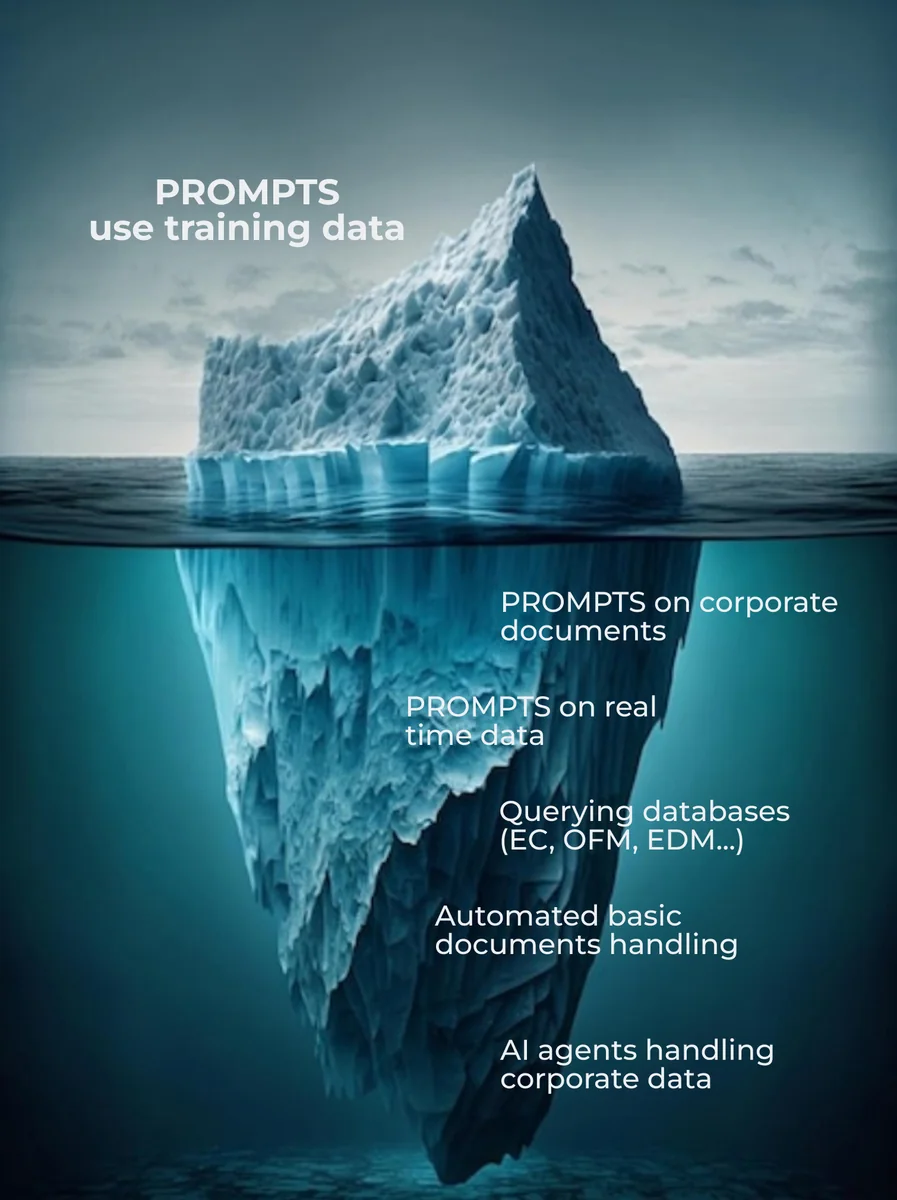
Why integrating LLM with corporate data?
- Basic use of LLM relies only on training dataset.
- Connecting LLM to corporate documents unlocks many more options and brings significantly more value.