Skip to content

The data is in five systems. The answer takes all afternoon.

We build AI agents and right-sized tools for the operational work that piles up – data buried across systems, knowledge lost in documents, reviews that eat senior time. Built by people who have run production, WRFM, projects, and process engineering, not generic IT with an AI label.

What we've built – and you can try right now

Sanitized versions run in a live demo, so you can use working tools instead of reading slides. Each has been delivered for real O&G operators – across Brunei, Kazakhstan, the UAE, and Malaysia. We bring reusable scaffolds and adapt them to your data, systems, and rules – not off-the-shelf, but not invented from scratch either. Alongside these agents we also run workforce enablement – more on that under How we engage.

AI Data Analyst

Engineers lose hours pulling data from production databases, historians and SharePoint, or waiting on someone to run a report. Ask in plain language; the agent works out where the answer lives, retrieves it, and returns figures, a chart, or a sourced answer.

Try it in the demo →
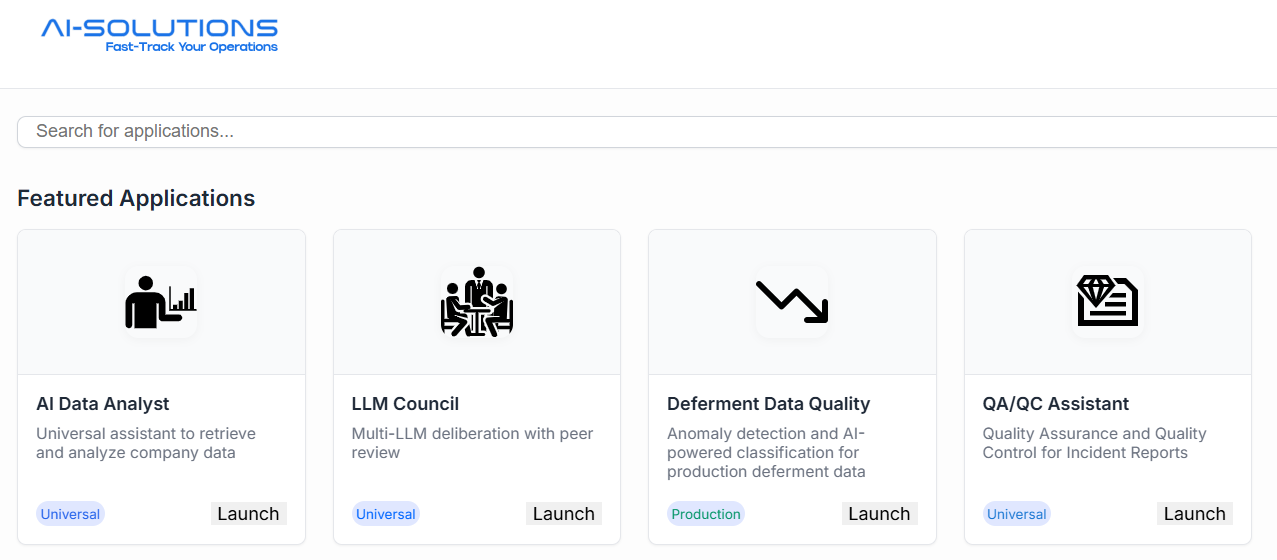
Deferment Data Quality assistant

Operational databases carry anomalies and misclassifications, and every day adds more – downstream reporting inherits all of them, which is real exposure in regulated reporting. An anomaly-detection engine runs on a schedule, checking incoming data and remediating what has already accumulated, with fixes applied at the source or as a separate repaired dataset.

Try it in the demo →

RCA QA/QC Gatekeeper

Recurring reviews eat senior time and still vary in quality, and weak submissions either slip through or trigger rework loops. This runs rule-based and AI-assisted checks before a document moves on and returns a clear ready / needs-refinement verdict with specific recommendations; the reviewer keeps the final call.

Try it in the demo →

These are three working examples. The same underlying patterns apply across production, WRFM, projects, operations, and corporate workflows.

  • Connected to production databases, historians, and document stores
  • First delivery measured in weeks
  • Client-owned deployment and handover

How we choose what fits

Repeatable workflow AI agent

For work that crosses systems, follows rules, and needs an audit trail.

Complex judgement Frontier LLM reasoning

For difficult questions where the relevant context can be assembled.

Stable logic Script or rules engine

For known logic where conventional software is cheaper, faster and easier to verify.

Choosing right matters more than choosing advanced. We'll recommend what actually works best in your environment – even when that's the smaller job for us.

How we engage

Enablement runs across both

Whichever format applies, an enablement track runs alongside it – coaching engineers and corporate functions to use AI safely and well. It absorbs everyday demand, keeps usage on governed platforms, and builds adoption momentum.

How engagements end

Every engagement transfers ownership – code, methodology, documentation, and templates handed over so your team owns and can extend what we build. Where useful we agree productivity metrics up front, so gains are visible rather than asserted. Every engagement should end with your people stronger, not dependent.

Let's find the workflow worth starting on.

A short call is the fastest way to see whether we're a fit – or try the working tools yourself first.